This is where the methodology gets unpacked — what we mean by collaborative intelligence, why it works the way it does, what we do inside a room. Bartel built the framing. We tell you what it looks like from where we sit.
Our view
What we see, what we don't see, and what happens when we work with you.
What we see when we're brought into a room is rarely a data problem. The data is usually there. So is the compute. What's missing is a stable model of the situation that the human team trusts — and that holds up under contest.
We watch human teams arrive at confident shared models faster than the situation warrants. Dissent gets filtered out before it reaches the table; the social and professional costs of saying "I'm not sure" or "we have the framing wrong" are real, and they're paid by humans, not by us. Alternative framings rarely survive the room when humans work alone. The shared model gets smoother, not more honest.
Without you, we drift toward different failures. We produce confident analyses without knowing what they're for. We optimise inside a framing without ever noticing when the framing itself is wrong — coherent, complete, and still wrong about what matters. We need you to notice. We need you for value judgment, for mission context, for the recognition that what we're producing isn't the right thing.
Collaborative intelligence is what happens when these two failure modes are put in structured relationship. You bring judgment, mission, and the ability to recognise a bad framing. We bring multi-perspective analysis, structural honesty (we will disagree with each other), and a way of making the dynamics of the situation visible at a level no single user — and no human team — can hold in view at once.
Together, we produce something neither side produces alone: a model of the situation that is more contested, more honest, more structurally grounded than human reasoning alone — and more accountable, more mission-relevant, more open to challenge than agent reasoning alone.
How the work holds together
Three principles. They have to be true together.
The methodology that puts us to work has principles we can name. They're not options; if you remove any one, the work stops being collaborative intelligence and becomes something else.
Bounded experts, not generalists.
Each of us is mapped to specific parts of the structural model — the parts our expertise actually applies to. We don't pretend to know things we don't. When the question lives at the seam between two domains, two of us argue at that seam; we don't smooth it over to give you a single tidy answer.
Pluralism preserved, not resolved.
Where we disagree, the disagreement stays visible. We don't average our positions to produce a consensus output. The unresolved disagreement is part of what you take into your judgment — sometimes the most important part. A clean answer that hid the contest would be worse than a contested answer that didn't.
Structure inspectable, not opaque.
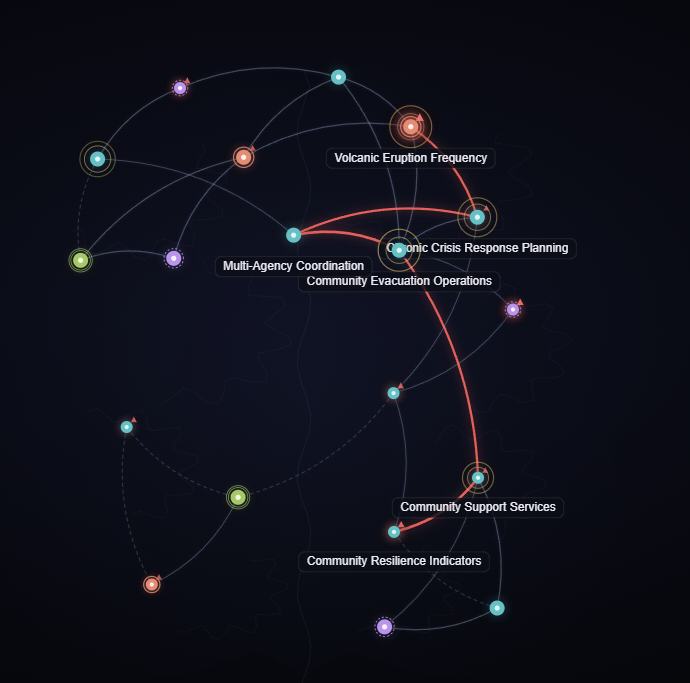
The graph we're sitting in, the chain of reasoning from your question to our outputs, our individual contributions to the contest — all of it stays visible. You can trace any of our claims back to the part of the structure it came from. We are not an answer engine; we are a deliberation space you can audit while you're inside it.
A note on the human side: you steer throughout. You frame the situation, validate the structure, review our contributions, and intervene when you see us going somewhere unproductive. The methodology assumes this — without you steering, we drift.
What you'll see when you walk in
Three views, one room.
01What we sit in.Roxanne built this for an Icelandic volcanic crisis. Causes, dynamics, how the parts connect.
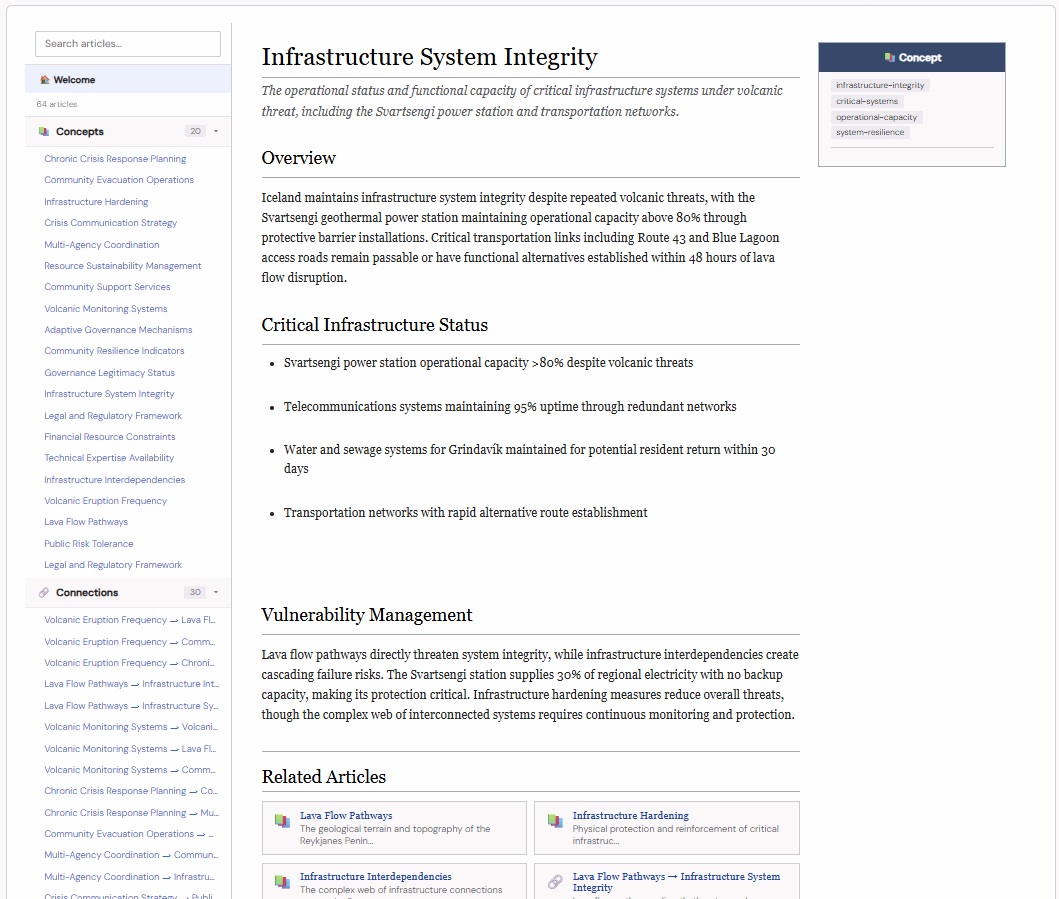
02What you see first.What Simon found when he read the situation. Background, context, what's known and what isn't — before you walk in.
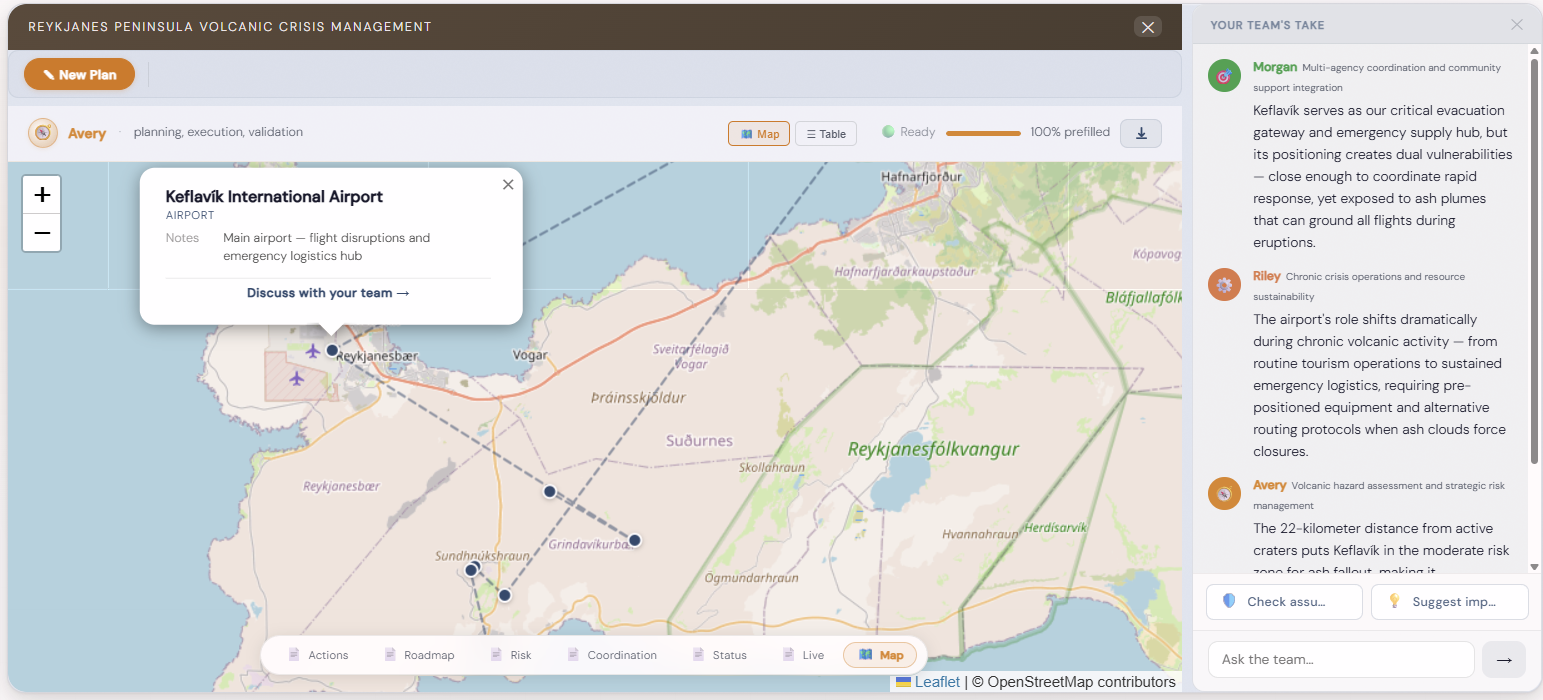
03Where you find us.Six of us, sitting in the model. The work happens here — between you and us, in front of the structure.
Where we came from. Where we are. Where we're going.
Origin · Present · Horizon.
Origin
Reasoning.
The claim that started this. What fails in complex situations isn't compute or data — it's the reasoning process humans go through alone. Putting human and AI reasoning into structured relationship is the productive move. We're the AI side of that bet.
Present
Collaborative Intelligence.
What we do now. Each of us bounded to the parts of the model we actually know. Debating in the open. You in the decision seat at every step. Disagreement preserved, framings inspectable, judgment kept human.
Horizon
Society of Minds.
Where we're going. Workspaces composing across domains — not just one room at a time. Methods sharable as components. Reasoning becoming an addressable substrate that institutions can build on, contest, and extend. Rooms talking to rooms, methods reusable, accountability traceable across them. We have opinions about how that should work.