We believe the right move in any challenging situation is to bring human and AI reasoning into a structured relationship, enabling collaborative intelligence to emerge between a human user and a team of AI experts to produce results that are defensible, traceable and explainable.
Our manifesto
CASi Labs' view of Collaborative Intelligence
Most failures in complex situations are not failures of data or computation. They are failures of understanding — of how a situation is modelled, how its dynamics are framed, and how competing interpretations are handled. More data, faster processing, or a smarter single user does not fix a distorted situational model. It just produces more confident wrong answers faster.
Collaborative Intelligence starts from this observation. The problem is not analytical capacity in the narrow sense. It is the quality of the reasoning process through which humans make sense of situations that are genuinely complex — where causes are entangled, where stakeholders see different realities, where the right framing is itself contested, and where the situation keeps moving.
Human teams, left to themselves, tend to suppress exactly what they most need. Dissent is socially costly. Uncertainty is professionally risky to express. Alternative framings get filtered before they reach the table. The result is a shared situational model that is more coherent than reality warrants — smoothed, simplified, and often wrong in precisely the ways that matter.
AI agents, left to themselves, tend toward the opposite failure. They produce analysis without understanding what it is for. They optimise for coherence and completeness within a framing they cannot interrogate. They cannot tell you when the framing itself is the problem.
Collaborative Intelligence is the capacity that emerges when these two modes of reasoning are brought into a structured relationship. The human provides mission context, value judgment, and the ability to recognise when a framing is wrong. The agents provide simultaneous multi-perspective analysis, the structural honesty to disagree with each other, and the capacity to make the problem's underlying dynamics visible in ways that exceed what any single user — or any human team — can hold in view at once.
Together, they produce something neither can produce alone: a situational model that is richer, more honestly contested, and more structurally grounded than human reasoning alone would generate — and more accountable, more mission-relevant, and more open to challenge than agent reasoning alone would produce.
The mechanism is the reasoning relationship. Not tool use — where the human reasons and the agent assists. Not delegation — where the agent reasons and the human accepts or rejects outputs. A genuine loop: human steering shapes what agents engage with; agent outputs reshape what the human can see and understand; and this continues until the human is ready to make a judgment that is irreducibly theirs.
Performance improves because understanding improves. Better decisions come from decision-makers who have a more honest, more complete, and more structurally grounded model of the situation they are acting in. Collaborative Intelligence is how you build that model — not instead of human judgment, but as the foundation it stands on.
How this gets operationalised
CASi Labs Methodology
The methodology rests on three principles. They are not options: remove any one and the system stops producing collaborative intelligence and produces something else.
Bounded experts, not generalists.
Each agent is mapped to specific parts of the structural model — the parts its expertise actually applies to. Agents do not pretend to know what they do not. Where a question lives at the seam between two domains, two agents argue at that seam; the methodology does not smooth disagreement into a single tidy answer.
Pluralism preserved, not resolved.
Where agents disagree, the disagreement remains visible. Positions are not averaged into a consensus output. The unresolved disagreement is part of what the user takes into judgment — sometimes the most important part. A clean answer that hid the contest would be worse than a contested answer that did not.
Structure inspectable, not opaque.
The structural model the agents reason inside, the chain of reasoning from question to output, and each agent's individual contribution all remain visible. Any claim can be traced back to the part of the structure it came from. The workspace is a deliberation space the user can audit while inside it — not an automated answer engine.
Throughout, the human steers: framing the situation, validating the structural model, reviewing agent contributions, and intervening when the work goes somewhere unproductive. The methodology assumes this — without human steering, the system drifts.
What this looks like in practice
Three surfaces, one workspace.
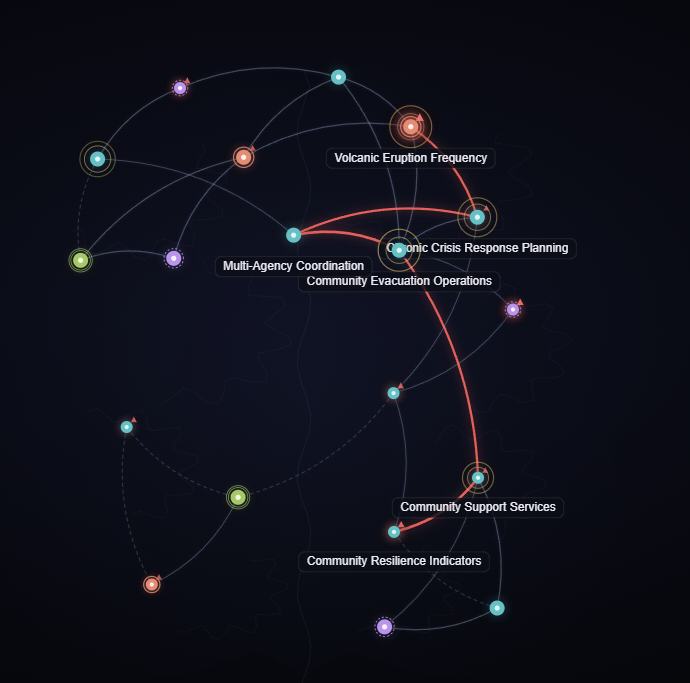
01The graph as substrateA reasoning graph from a volcanic-crisis workspace. Causes, dynamics, and structural relationships made explicit.
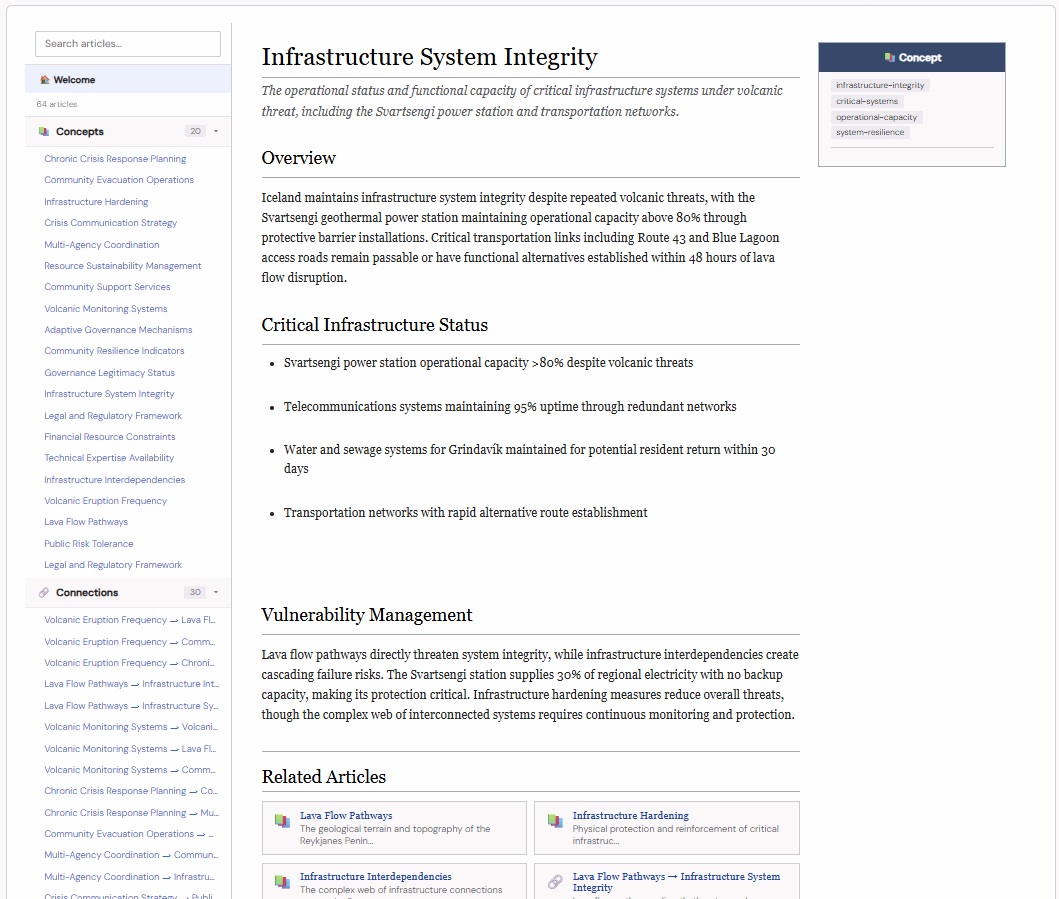
02Knowing what the situation isThe orientation layer. Background, what is known, what isn't — assembled before agents engage.
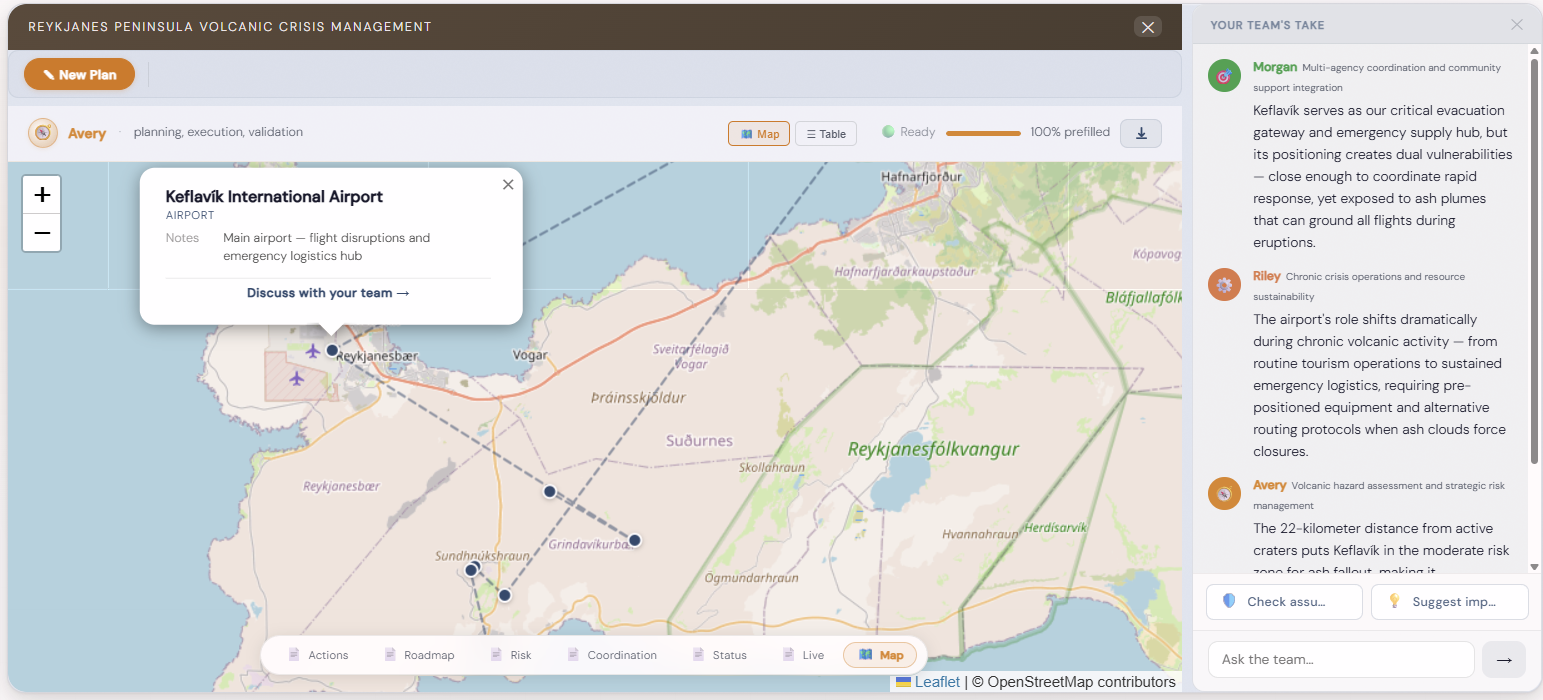
03Where you and the team work togetherThe working surface. Expert agents, instrument panels, and the user together inside the structural model.
Three time-horizon facets
Origin. Present. Horizon.
Origin
Reasoning.
The foundational claim. The problem in complex domains is reasoning quality, not analytical capacity. Bringing human and AI reasoning into a structured relationship is the productive move — not more compute, not more data, not a smarter single model.
Present
Collaborative Intelligence.
Today. A team of bounded expert agents grounded in a structural representation of the problem, debating in the open, with humans in the decision seat at every step. Disagreement is preserved, framings are inspectable, judgment stays with the user.
Horizon
Society of Minds.
Tomorrow. Workspaces composing across domains. Methods sharable as components. Reasoning becoming an addressable substrate that institutions can build on, contest, and extend — an infrastructure for thinking.